/

It’s no secret that Pilates is having a moment. For the third year in a row, it was the most-booked workout on ClassPass with reservations climbing 66% year over year and over 15 million classes booked in 2025 alone. Mat Pilates bookings jumped 114%. High-intensity Pilates climbed 27%. And the workout that started a century ago is now the first class most new ClassPass users book and the most rebooked format in every region of the world.
So how did Pilates go from niche to everywhere? And more importantly, what's the surge telling us about how people actually want to train in 2026?
Joseph Pilates developed his method during WWI while held as a prisoner of war. He worked with fellow internees to help them recover from the physical toll of the war and famously rigged springs to hospital beds to help bed-ridden POWs build strength against resistance. Those early contraptions became the prototypes for the Reformer, the machine most people now associate with Pilates studios.
After the war, Pilates emigrated to the U.S. and opened a studio in New York, where he worked extensively with dancers rehabbing injuries. He called his method "Contrology." The name didn't stick. The system did. For decades, Pilates lived quietly. It picked up steam in the 1980s as celebrities started talking about it, and it broke into the mainstream in the 1990s. Then it plateaued. From the early 2000s through the late 2010s, yoga and high-intensity interval training pulled most of the cultural oxygen out of the room, and Pilates settled into the background as a respected but unflashy option.
That's the part of the story most people know. The more interesting part is what's happening now.
The current surge isn't really about Pilates suddenly inventing something new. It's about Pilates being exactly what a lot of people are looking for right now. Three shifts are driving it.
For most of the last decade, the loudest voice in fitness was the one telling you to push harder, sleep less, and embrace the grind. That voice is getting quieter. Pilates is purpose-built for that mindset. It's low-impact, deeply intentional, and grounded in the principle that better movement comes from better control, not from more punishment. You leave a Pilates class feeling worked, not wrecked. For a lot of people, that's the entire appeal.
Ask members what they're training for these days and the answer is changing. Less "summer body," more "still hiking fourteeners at 70." Longevity, injury prevention, joint health, and movement quality have moved to the front of the conversation, and they're not going back. Pilates checks every box. It builds the deep core stability, hip control, and spinal awareness that protect you under load in every other workout. It improves posture in a world that spends most of its waking hours hunched over screens. If you're planning to train hard for the next forty years, Pilates is one of the smartest tools you can add to your routine.
For decades, Pilates carried a perception that it was a women's workout. That's finally breaking down. Equinox now reports up to 25% male attendance in some of its Pilates classes. Other studios are seeing male participation jump from around 10% a few years ago to 30% today. Half of one prominent Pilates educator's private clients are now men.
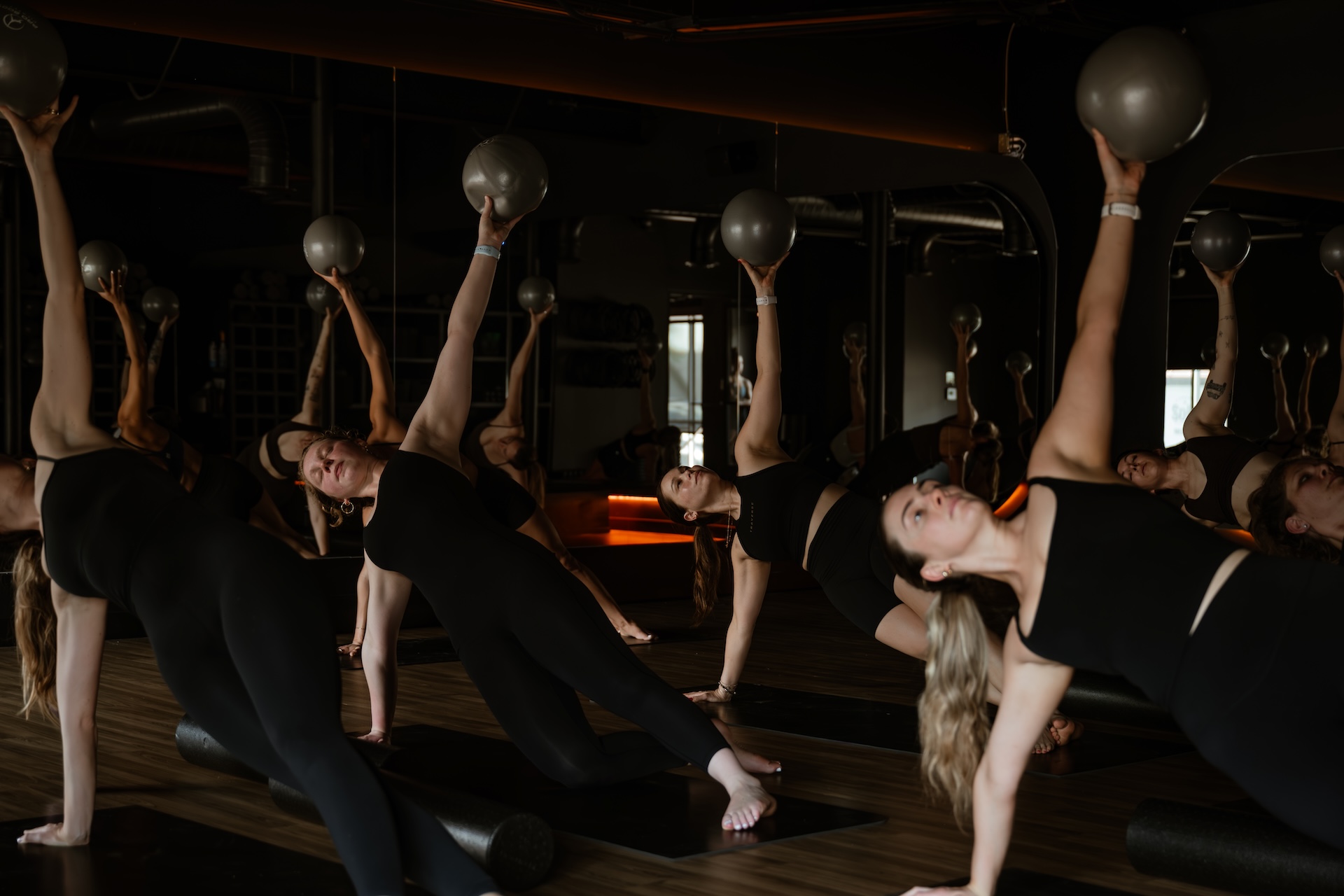
Our take on mat Pilates is a class called Core. It lives in the Movement Studio where the room is infrared-heated to warm the muscles, support deeper range of motion, and turn up the intensity in a way that rewards focus. Core is built around classical mat Pilates foundations with targeted core engagement, deep activation, controlled time under tension and then reimagined for the Traverse athlete.
A few things worth knowing before your first class:
Pilates isn't a trend. It's a hundred-year-old method that's finally getting the attention it deserves, and the surge isn't going anywhere so try a Core class on us.